exhibitions
Presence. Maria Michałowska
Presence. Maria Michałowska
Arton Foundation
Foksal 11/4, Warsaw
April 26–May 25, 2025
Organizers:
Arton Foundation
www.fundacjaarton.pl
Culture and Art Centre in Wrocław
www.okis.pl
Curator: Marika Kuźmicz
Initiators of Maria Michałowska's exhibitions: Agnieszka Chodysz-Foryś, Igor Wójcik
Collaboration: Agnieszka Chodysz-Foryś, Adam Parol
Graphic design: Agnieszka Probola
"And again the same. An elusive, fading, and lingering presence."
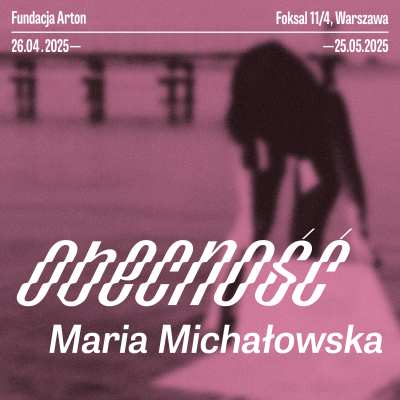
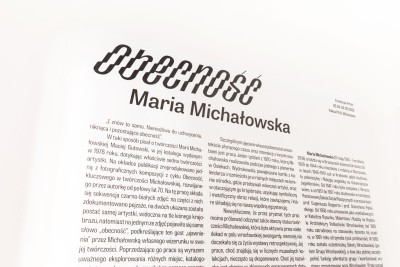
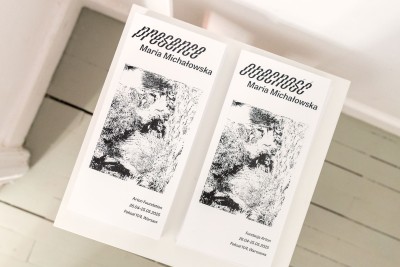
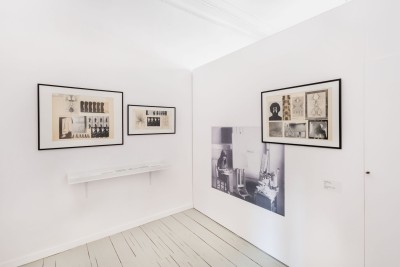
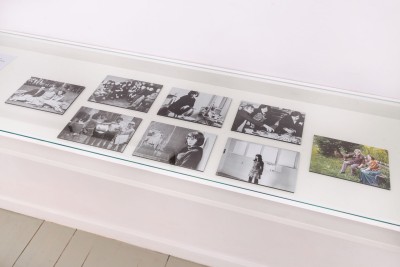
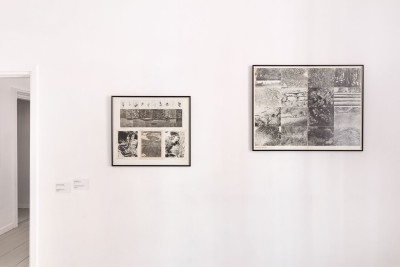
This is how Maciej Gutowski described Maria Michałowska's work in her 1978 catalog, capturing the essence of her artistic practice. The cover features a reproduction from the Presence series – one of the central parts of Michałowska's oeuvre, developed since the mid-1970s. The work consists of a sequence of black-and-white photographs: some depict landscapes, two show the artist herself against a forest backdrop, and one contains the word "presence," highlighting the act of revealing her own image within the work. The other photographs reflect a careful exploration of various locations, documenting grass, forest, water, and rocks, as if the artist were trying to precisely identify the places she found herself in, trying to understand her relationship with the world.
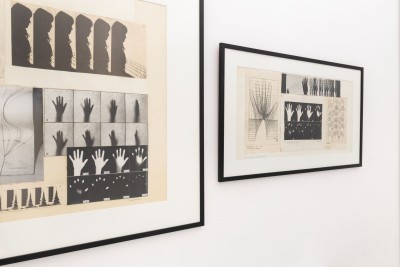
Before this project, in the early 1970s, Michałowska began work on the drawing series Multiplications, Self-portraits (1972), Traces (1972), and Transformations (1973). They are linked by recurring motifs: the outline of a face or the tracing of the artist's hand, reduced to a multiplied sign or line that, through repetition, creates specific aesthetic effects. In these works, Michałowska is both visible and hidden – her presence is paradoxical, reduced to a minimal form. On closer inspection, we also notice the presence of others: her students, friends, and long-time partner Zdzisław Jurkiewicz, whom she invited to co-create the works. In her memoirs, Michałowska recalls inviting various people to her studio, tracing their hands or the outlines of their facial profiles on paper, which resulted in a kind of an intimate diary created with those who shared and shaped her everyday reality.
A distinct approach to her own presence, framed by the passage of time and interactions with others, appears in the work One Week from 1970, created during one of the open-air festivals in Osieki. Michałowska printed enlarged calendar pages and placed them in various locations around the centre where the artists were staying and the surrounding landscape, creating a symbolic and metaphysical image of the relationships we form and which make up our shared existence.
Through the lens of these works, one might also attempt to interpret the current status of Michałowska's practice. Although active for many decades within the Wrocław avant-garde, she never had a retrospective exhibition during her lifetime. Her works, while held in numerous museum collections, are rarely shown. And although her name appears in collective studies on the art of the 1960s and 70s, her oeuvre remains open to interpretation and calls for deeper investigation. The exhibition by the Arton Foundation, organized in collaboration with the Culture and Art Centre in Wrocław, offers such an opportunity – while also contributing to the cataloguing and researching of the artist's private archive.
Maria Michałowska (31 May 1925 – 1 September 2018) was born in Brzeżany (now Berezhany, Ukraine). From 1929 to 1944, she lived with her family in Warsaw, and from 1945 to 1947 in Krakow, where she studied Polish and English philology at the Jagiellonian University. From 1947 she was associated with Wrocław, where she studied at the State Higher School of Fine Arts from 1951 to 1957 under Prof. Eugeniusz Geppert and Prof. Stanisław Pękalski. From 1958, she worked as a teacher in the Department of Drawing, Painting and Sculpture at the Faculty of Architecture of Wrocław Polytechnic (from 1982, she held the position of an associate professor, in 1991 she received the title of professor). In 1965 she joined the Wrocław School (later – Wrocław Group), and after two years she took on the responsibilities of the group's secretary, coordinating exhibitions organized outside Wrocław. For more than five decades, she was an active member of the Wrocław avant-garde milieu. She participated in some of the most important events that were groundbreaking for Polish art, such as the Wrocław '70 Art Symposium, the SP. Conceptual Art exhibition (1970), International Meetings of Artists, Scientists and Art Theorists in Osieki (1967) and Atelier 72 in Edinburgh (1972). She had around a dozen individual exhibitions and took part in many group exhibitions in Poland and abroad.
The exhibition is accompanied by a monograph on the work of Maria Michałowska, edited by Marika Kuźmicz with texts by Marika Kuźmicz, Luiza Nader, Małgorzata Devosges-Cuber, and Małgorzata Miśniakiewicz, published in 2024 by the Culture and Art Centre in Wrocław.
Co-financed from the budget of the Lower Silesian Voivodeship Local Government
The Marshal of the Lower Silesia Region took the honorary patronage of the event
Arton Foundation
Foksal 11/4, Warsaw
April 26–May 25, 2025
Organizers:
Arton Foundation
www.fundacjaarton.pl
Culture and Art Centre in Wrocław
www.okis.pl
Curator: Marika Kuźmicz
Initiators of Maria Michałowska's exhibitions: Agnieszka Chodysz-Foryś, Igor Wójcik
Collaboration: Agnieszka Chodysz-Foryś, Adam Parol
Graphic design: Agnieszka Probola
"And again the same. An elusive, fading, and lingering presence."
This is how Maciej Gutowski described Maria Michałowska's work in her 1978 catalog, capturing the essence of her artistic practice. The cover features a reproduction from the Presence series – one of the central parts of Michałowska's oeuvre, developed since the mid-1970s. The work consists of a sequence of black-and-white photographs: some depict landscapes, two show the artist herself against a forest backdrop, and one contains the word "presence," highlighting the act of revealing her own image within the work. The other photographs reflect a careful exploration of various locations, documenting grass, forest, water, and rocks, as if the artist were trying to precisely identify the places she found herself in, trying to understand her relationship with the world.
Before this project, in the early 1970s, Michałowska began work on the drawing series Multiplications, Self-portraits (1972), Traces (1972), and Transformations (1973). They are linked by recurring motifs: the outline of a face or the tracing of the artist's hand, reduced to a multiplied sign or line that, through repetition, creates specific aesthetic effects. In these works, Michałowska is both visible and hidden – her presence is paradoxical, reduced to a minimal form. On closer inspection, we also notice the presence of others: her students, friends, and long-time partner Zdzisław Jurkiewicz, whom she invited to co-create the works. In her memoirs, Michałowska recalls inviting various people to her studio, tracing their hands or the outlines of their facial profiles on paper, which resulted in a kind of an intimate diary created with those who shared and shaped her everyday reality.
A distinct approach to her own presence, framed by the passage of time and interactions with others, appears in the work One Week from 1970, created during one of the open-air festivals in Osieki. Michałowska printed enlarged calendar pages and placed them in various locations around the centre where the artists were staying and the surrounding landscape, creating a symbolic and metaphysical image of the relationships we form and which make up our shared existence.
Through the lens of these works, one might also attempt to interpret the current status of Michałowska's practice. Although active for many decades within the Wrocław avant-garde, she never had a retrospective exhibition during her lifetime. Her works, while held in numerous museum collections, are rarely shown. And although her name appears in collective studies on the art of the 1960s and 70s, her oeuvre remains open to interpretation and calls for deeper investigation. The exhibition by the Arton Foundation, organized in collaboration with the Culture and Art Centre in Wrocław, offers such an opportunity – while also contributing to the cataloguing and researching of the artist's private archive.
Maria Michałowska (31 May 1925 – 1 September 2018) was born in Brzeżany (now Berezhany, Ukraine). From 1929 to 1944, she lived with her family in Warsaw, and from 1945 to 1947 in Krakow, where she studied Polish and English philology at the Jagiellonian University. From 1947 she was associated with Wrocław, where she studied at the State Higher School of Fine Arts from 1951 to 1957 under Prof. Eugeniusz Geppert and Prof. Stanisław Pękalski. From 1958, she worked as a teacher in the Department of Drawing, Painting and Sculpture at the Faculty of Architecture of Wrocław Polytechnic (from 1982, she held the position of an associate professor, in 1991 she received the title of professor). In 1965 she joined the Wrocław School (later – Wrocław Group), and after two years she took on the responsibilities of the group's secretary, coordinating exhibitions organized outside Wrocław. For more than five decades, she was an active member of the Wrocław avant-garde milieu. She participated in some of the most important events that were groundbreaking for Polish art, such as the Wrocław '70 Art Symposium, the SP. Conceptual Art exhibition (1970), International Meetings of Artists, Scientists and Art Theorists in Osieki (1967) and Atelier 72 in Edinburgh (1972). She had around a dozen individual exhibitions and took part in many group exhibitions in Poland and abroad.
The exhibition is accompanied by a monograph on the work of Maria Michałowska, edited by Marika Kuźmicz with texts by Marika Kuźmicz, Luiza Nader, Małgorzata Devosges-Cuber, and Małgorzata Miśniakiewicz, published in 2024 by the Culture and Art Centre in Wrocław.
Co-financed from the budget of the Lower Silesian Voivodeship Local Government
The Marshal of the Lower Silesia Region took the honorary patronage of the event
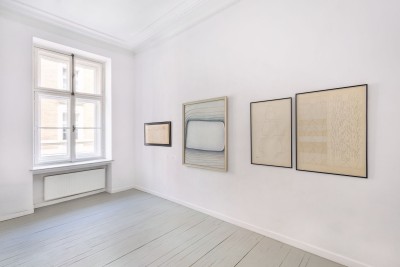
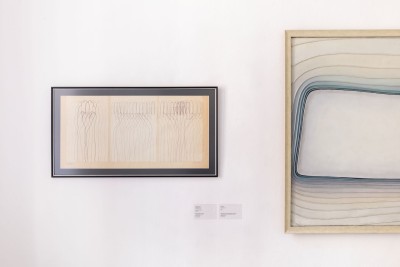
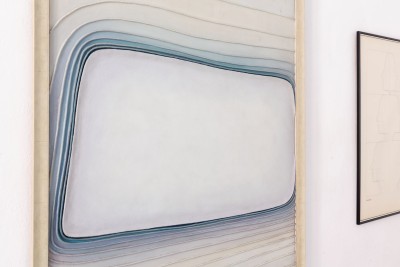
View of the exhibition "Presence. Maria Michałowska"
Alexander Kot-Zaitsaŭ
Other exhibitions
-
 exhibitions
Natural Situations: Agnieszka Niziurska
-
 exhibitions
Parts. Zofia Glazer-Rudzińska
-
 exhibitions
Social History. 70 years of the gallery at Rynek Starego Miasta 2
-
 exhibitions
70th Anniversary of the Gallery at the Old Town Cultural Centre
-
 exhibitions
Such Was My Dream. Joanna Stańko
-
 exhibitions
Barbara Maroń. A Story Within a Story
-
 exhibitions
Applied Herstories: Irena Huml
-
 exhibitions
Grown in Love: Liliana Mikołajewska-Jansen
-
 exhibitions
Mirrors and Screens: Małgorzata Potocka, Jagoda Kaloper
-
 exhibitions
Places for Deliberation. Barbara Kozłowska
-
 exhibitions
Małgorzata Rittersschild. The Lizard Means Short-Lived Happiness
-
 exhibitions
Beyond Documentation Imaginations Emerge. Anna and Krystian Jarnuszkiewicz
-
 exhibitions
Argentine Experiment: CAyC and CSSR
-
 exhibitions
Jolanta Owidzka. I Wouldn’t Dare Walk on a Work of Art
-
 exhibitions
Open Jagoda Przybylak Studio
-
 exhibitions
Jagoda Przybylak: "... must see"
-
 exhibitions
Maria Michałowska: At the End of This Road I Might Find a Mirror exhibition
-
 exhibitions
Looking Into The Sun. Hanna Orzechowska
-
 exhibitions
Motifs: Krystyna Szczepanowska-Miklaszewska
-
 exhibitions
You Will Hear When You See Me
-
 exhibitions
Jagoda Przybylak: “... must see”
-
 exhibitions
Ties and Threads: Herstories of Eleonora Plutyńska
-
 exhibitions
The less work, the better effect. Liliana Lewicka
-
 exhibitions
Anna Buczkowska
-
 exhibitions
Wspólny splot
-
 exhibitions
Hanna Orzechowska. W relacji / In relation
-
 exhibitions
wystawa Pawła Kwieka "Zrobić niemożliwe światło"
-
 exhibitions
Małgorzata Potocka
-
 exhibitions
P.S. Warunkiem uczestnictwa jest praca twórcza. Mikrohistorie plenerow w Osiekach
-
 exhibitions
Who is Janina Węgrzynowska?
-
 exhibitions
Anna Ciba: When You Look Into My Eyes, What Do You See?
-
 exhibitions
Małgorzata Potocka. We Don’t Need Other Words When We Have Mirrors
-
 exhibitions
Zdzisław Jurkiewicz. Sun in the Kitchen
-
 exhibitions
CLICK. Sexualisation of Food in Art
-
 exhibitions
Andrij Bojarov / Андрій Бояров: Koło i kula / Коло і куля
-
 exhibitions
Tapta
-
 exhibitions
Sisters: Alicja & Bożena Wahl
-
 exhibitions
Zdzisław Jurkiewicz. Occurrences
-
 exhibitions
Three Things I Love in Life: the Car, Liquor, and Sailors
-
 exhibitions
Phony Smile. Language of Aesthetic Speculation in Croatian Photography
-
 exhibitions
Exhibition Laboratory of Presentation Techniques
-
 exhibitions
Barbara Kozłowska. Linia
-
 exhibitions
Barbara Kozłowska. You Can See It All Anywhere
-
 exhibitions
Soft shooting? Introducing the History of Women’s Photography in Croatia
-
 exhibitions
Out in the Fresh Air? Early Ecological Projects during Artistic Plein-Airs in Poland
-
 exhibitions
At The Worlds Table. Zdzisław Jurkiewicz
-
 exhibitions
The Case of Jadwiga S.
-
 exhibitions
IN. Ludmiła Popiel i Jerzy Fedorowicz
-
 exhibitions
Womens Art, Iwona Lemke-Konart
-
 exhibitions
Paweł Kwiek. Time Difference
-
 exhibitions
Formy nikłe. Ludmiła Popiel & Jerzy Fedorowicz
-
 exhibitions
Nie mów, że urodziłeś się w złym czasie
-
 exhibitions
1: 11 Microstories
-
 exhibitions
I lay and fly away
-
 exhibitions
Wystawa Jolanty Marcolli w BWA Zielona Góra
-
 exhibitions
Ja to ktoś inny / Bruce Nauman / Krzysztof Niemczyk
-
 exhibitions
Video Killed The TV Star
-
 exhibitions
If you dont know me by now, you will never never never know me
-
 exhibitions
Arton Review Europe - exhibition and film screening
-
 exhibitions
Ludmiła Popiel
-
 exhibitions
Doing the Impossible Light
-
 exhibitions
Jolanta Marcolla. A Room of One’s Own
-
 exhibitions
across realities Wojciech Bruszewski / Mateusz Sadowski
-
 exhibitions
Andrzej Jórczak. Looking at Alpha Ursae
-
 exhibitions
6 meters before Paris - Eustachy Kossakowski
-
 exhibitions
Polska Fotografia Konceptualna
-
 exhibitions
Conceptualism. Photographic medium.
-
 exhibitions
Barbara Kozłowska Wszystko to możesz zobaczyć gdziekolwiek
-
 exhibitions
Zdarzenia. Zdzisław Jurkiewicz